04 How the machine works
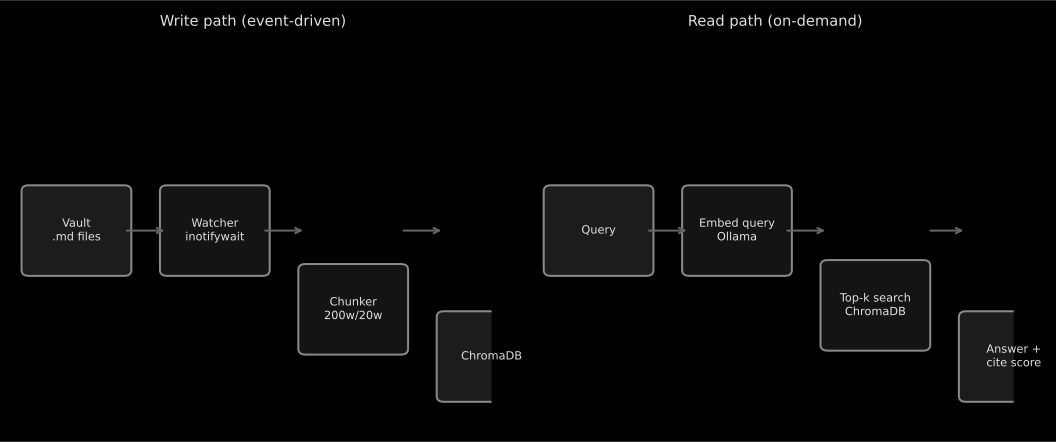
Diagrams generated from the implementation. Click any image to zoom.
Local · Private · Accurate
An AI assistant that remembers your notes — finds the right one, answers only from it, shows the source, and says “I don’t know” instead of making things up.
The system runs as a nine-stage pipeline. Select a node, press Play to step through each stage, or drag and zoom the diagram.
Loading interactive diagram…
Every AI assistant forgets your context. This system does not. It works in three steps:
Your markdown notes are read and organised into a private search index — all on your own machine, nothing leaves it.
When you ask a question, the system picks the few notes that are actually about it — not every note you own.
The AI answers only from those notes and shows its source. If nothing matches well enough, it says “I don’t know”.
AI is billed per “token” (roughly, per word it reads). Most AI tools paste everything into the conversation. This system only sends the few notes that match your question.
Real example
You have 1,000 notes. You ask a question. Only the 3 most relevant notes are sent to the AI. That’s ~99% less text — cheaper and much faster answers.
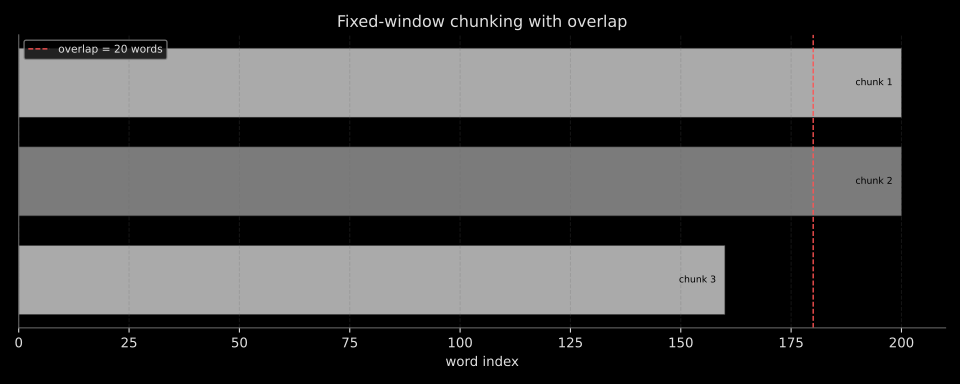
Notes are split into small chunks (about 200 words each) so the AI can retrieve exactly the piece it needs, and unchanged notes are skipped on re-index so we don’t re-process them again.
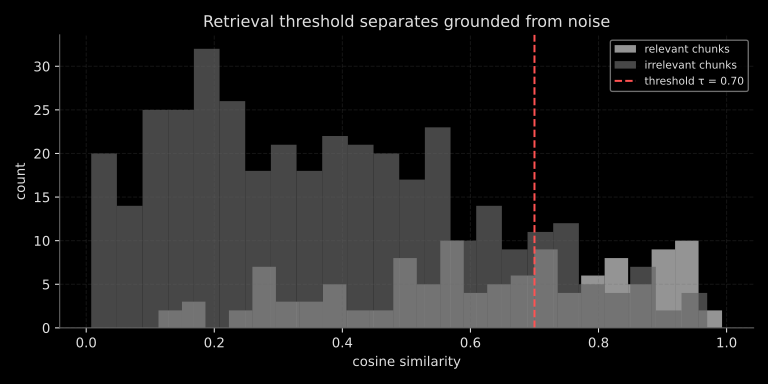
Generic AI can “hallucinate” — confidently invent answers when it doesn’t know. This system forces the AI to answer only from your notes and to show its source and a match score.
Real example
Before: “Your last project used a cloud database.” (invented)
After: “Your last project used a local database. Source: local-retrieval-pipeline.md · match 0.96.” (true, with proof)
Two rules enforce this: the system prompt says “answer only from the retrieved chunks and cite the source”, and a similarity threshold means low-confidence questions are refused rather than invented.
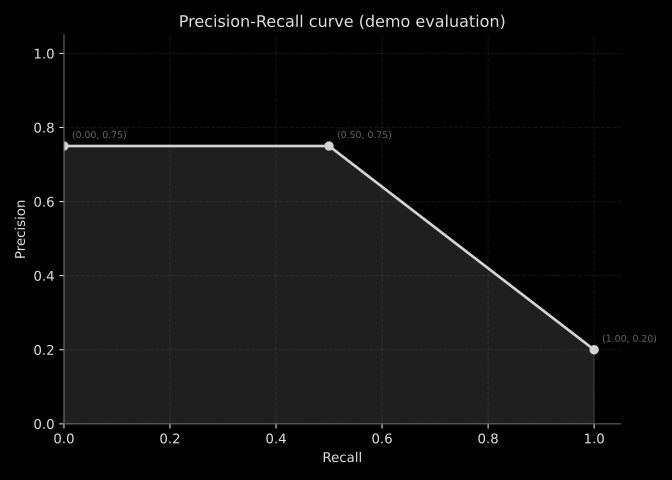
Because answers are built from your own notes instead of the AI’s guesses, they match what you actually wrote — and we measure that accuracy so you can trust it.
Real example (measured on our demo vault)
The right note is the top result 75% of the time, and the right note is always found within the top 5 (100% recall).
python3 scripts/evaluate_retrieval.py to regenerate the numbers on your own notes.Diagrams generated from the implementation. Click any image to zoom.
What each formula means, where it is used, and why.
We measured it on a small test set. Regenerate anytime with python3 scripts/evaluate_retrieval.py.
Loading evaluation results…